
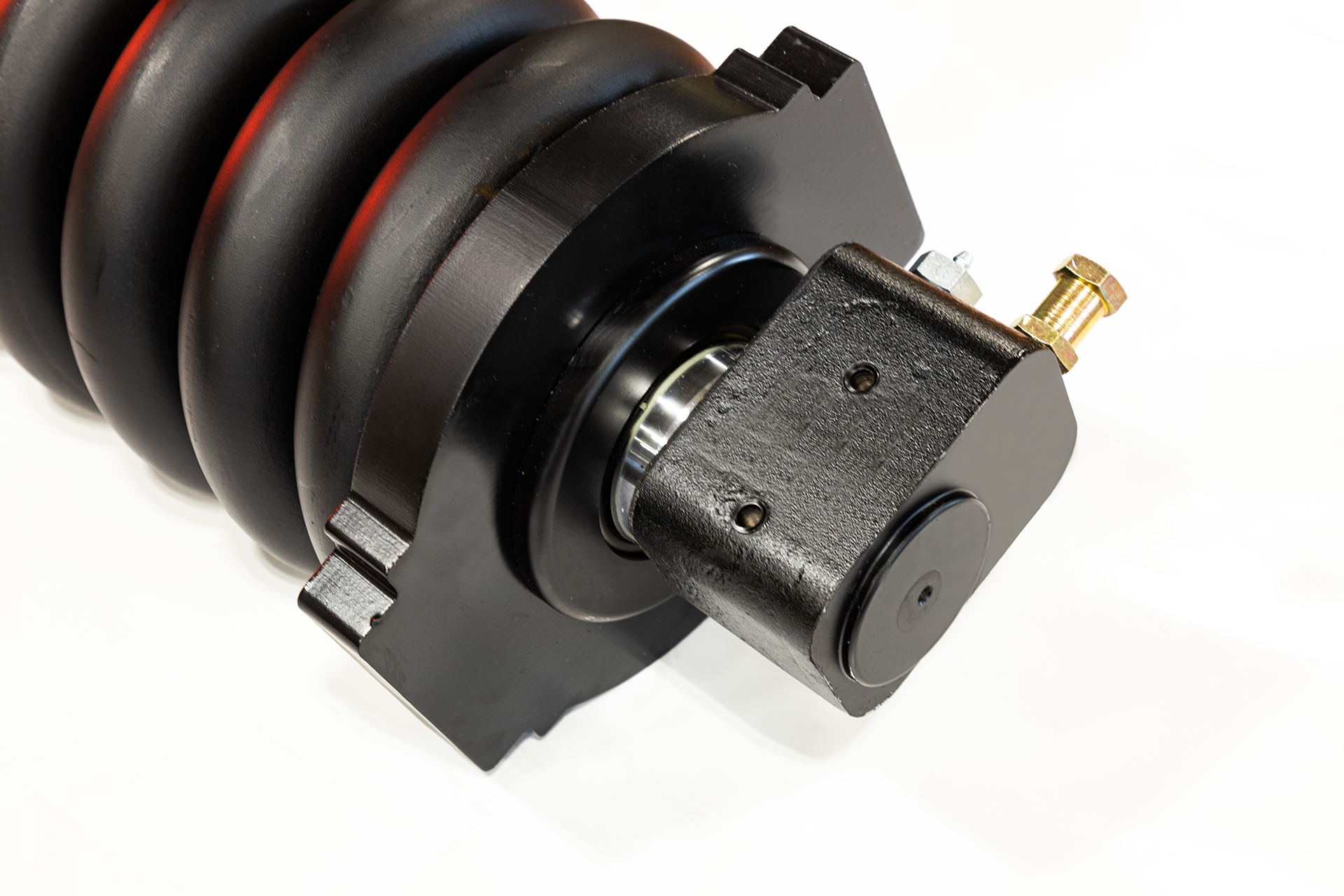
Track adjusters maintain the chain’s tension in tracked vehicles of all sizes through a combination of actions.
The first article on track adjusters delves into the types, functions, and components of this essential part of earthmoving machines.
Track adjusters maintain the chain at the correct tension in tracked earthmoving machines of all sizes. That’s why it’s essential for the machine’s operation. Before digging deeper into its functions, let’s look at its components. The main parts are the following:
- the yoke, which connects the idler wheel to the other parts;
- the recoil spring, which serves as a shock absorber, protecting the undercarriage from impacts and overload and adjusting to uneven soil;
- the cylinder, which adjusts the track and tensions the chain. It includes a grease cylinder. Moreover, the track cylinder can be installed outside or inside the spring, with its pros and cons.
Track adjuster functions
The track adjuster is designed to carry out a set of essential functions inside an earthmoving machine. In detail:
- It exerts a bending action and guides the track via sliding supports and the idler wheel;
- It pre-tensions and adjusts the chain;
- It protects the undercarriage from external overload;
- It ensures safe shock absorption.
How many types of track adjusters are there?
There’re several, even though they all serve the same purpose. Depending on the components’ layout and the type of tracked vehicle, we can divide track adjusters into two groups. Let’s look at them and see how they differ from each other.
1. Front track adjuster with separate track cylinder

2. Front track adjuster with built-in track cylinder

The recoil spring and the hydraulic track cylinder
The recoil spring and the cylinder are two essential parts of the track adjuster. Both parts serve a specific purpose.
The spring absorbs the shocks applied to the front idler when the machine meets an obstacle. Moreover, it adjusts the chain’s tension by injecting grease inside the cylinder through a control valve that moves the recoil spring forwards through hydraulic pressure.
On the contrary, the recoil spring moves backwards by making grease leak from the valve, thus reducing the chain’s tension. The recoil spring is loaded when the machine moves backwards.
The cylinder holds the spring with the cylinder body (sleeve). This way, it keeps the spring constantly preloaded. This part is highly resistant because it receives a heavier load when the spring is compressed than when it’s preloaded.
Generally, the recoil spring and the cylinder can include the following components:
-
Spring
-
Cylinder
-
Piston
-
Tie-rod
-
Flange
-
Seal
-
Oil scraper
-
Nut
This is what they usually look like:
Recoil spring

Hydraulic track cylinder

Recoil spring with built-in track cylinder

The next article will dig deeper into the recoil spring.
Want to know more about ITR’s track adjusters?
Contact us for further information!